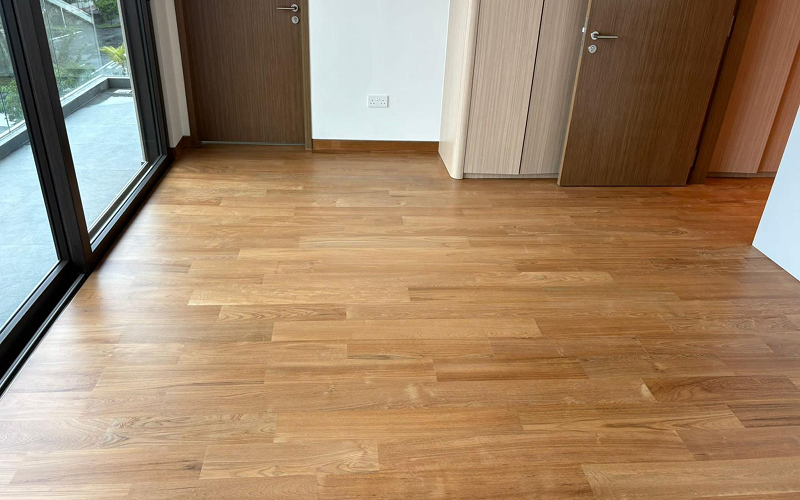
Key Takeaways
- Singapore’s humidity affects all wood flooring, making proper installation, acclimatisation, and indoor climate control essential for long-term performance.
- Engineered wood flooring offers short-term stability, but its limited surface layer reduces the ability to refinish, often leading to earlier replacement.
- Solid hardwood flooring supports long-term use through repeated sanding and refinishing, allowing the material to age and adapt rather than wear out.
- Choosing between the different types of wood flooring is not just about upfront cost, but about lifecycle value, where renewable materials like solid timber reduce the need for full replacement over time.
Choosing the Right Wood Flooring for Singapore Homes
Most people focus on a floor’s appearance: the tone, the grain, and how it complements the space. However, in Singapore, appearance is only part of the story. Performance often becomes the more important factor over time.
The types of wood flooring available today range from layered constructions to full timber planks, each responding differently to heat, moisture, and everyday use. What lies beneath your feet is more than just a surface finish; it is a material choice that subtly influences how your home settles, how comfortable it is to live in, and how often the floor needs repair, refreshing, or replacement.
When considering how wood behaves in tropical conditions, the reasons for this become clear. Material integrity and the ability to renew the surface become just as important as the floor’s initial appearance.
Common Types of Wood Flooring Available
Before comparing performance, it’s helpful to understand the main types of wood flooring commonly found in Singapore homes today.
Solid Hardwood Flooring
Crafted from a single piece of timber, this option can be repeatedly sanded and refinished over time. It is often chosen for its long-term use and material longevity.
Engineered Wood Flooring
Built with a layered core and a thin hardwood surface, this construction is designed to reduce visible movement caused by humidity.
Wood Parquet Flooring
Made up of smaller timber pieces arranged in patterns, parquet offers design flexibility while still allowing for selective restoration in many cases.
Other alternatives, such as laminate or vinyl, may mimic the look of wood, but they do not offer the same material properties or refinishing potential.
How Singapore’s Humidity Affects All Wood Flooring
In Singapore, humidity is a constant presence, subtly influencing the behaviour of materials. As a natural material, timber responds by absorbing and releasing moisture, expanding and contracting incrementally.
This movement is not a flaw; it is simply part of the material’s natural behaviour. Problems tend to arise only when this natural movement is restricted or when the installation fails to adequately consider the environment.
Therefore, choosing wood flooring for humid climates requires more than just selecting the right material. Careful spacing, thorough subfloor preparation, and sufficient acclimatisation are all essential. Without these precautions, even the finest floor can develop gaps, slight warping, or surface tension over time.
Indoor conditions are equally important. Stable temperature and humidity levels allow the wood to settle more comfortably, minimising stress across the floor. Ultimately, across all types of wood flooring, the crucial factor is not just the construction, but how well the material can adapt, breathe, and maintain its balance within the home.
Understanding Engineered Flooring in the Local Market
In many newer homes across Singapore, engineered wood flooring is often presented as a practical solution to humidity. Its layered construction, typically a plywood or composite core with a thin hardwood surface, is designed to control movement and minimise visible changes.
On the surface, it appears well-suited for tropical conditions. The planks sit neatly, installation is usually quicker, and the floor appears stable from the start.
However, this structure has a limitation that is easily overlooked: the relatively thin top hardwood layer. Over time, as the surface wears with daily use, the ability to sand and refinish it becomes limited, or even impossible. Once that layer is damaged, replacement often becomes the only viable option.
This affects the flooring’s long-term performance. What starts as a convenient and stable solution can lead to a shorter renewal cycle, especially in areas with heavy foot traffic or frequent use.
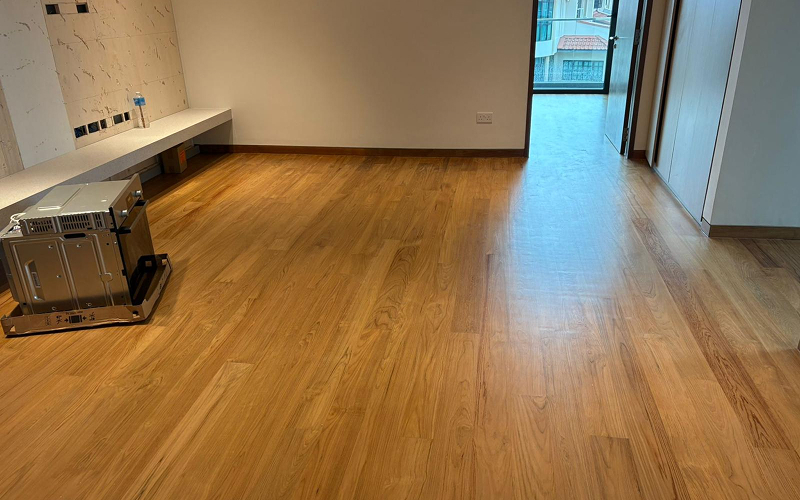
Why Solid Hardwood Planks Remain a Long-Term Material Choice
In contrast, solid hardwood flooring consists of a single piece of timber. This simplicity is significant: without layered components, the material maintains its structure more consistently over time, allowing it to be repaired rather than replaced.
Surface marks, scratches, or even colour shifts are not permanent problems. The floor can be sanded and refinished repeatedly, restoring its surface while keeping the original structure intact. Over the years, this changes how the material is experienced, becoming something that adapts, rather than something that simply wears out.
Instead of appearing worn, the floor begins to show depth, with slight variations in tone, a softening of grain, and a finish that feels more lived-in. These details build character in a way that newer surfaces often cannot replicate.
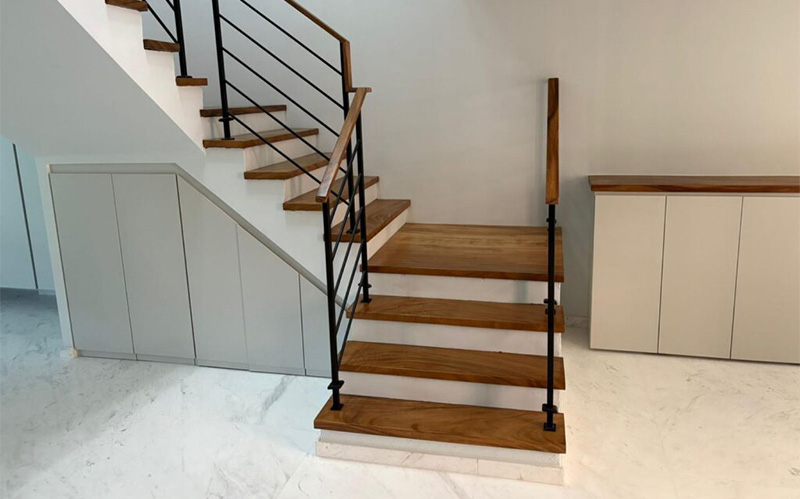
The choice of timber also shapes the floor’s performance. Dense species such as teak wood offer natural resistance to moisture and everyday wear, making them well-suited to humid conditions. Meanwhile, more expressive materials like suar wood bring a bold grain pattern and visual warmth, often used to anchor a space or create a stronger design identity.
For homeowners considering their options, the appeal goes beyond durability. It lies in adaptability: the floor settles into the home, evolving alongside it, rather than reaching a point where it needs to be removed and replaced.
Cost, Maintenance, and Lifecycle Considerations
Engineered flooring can seem like the obvious choice initially. Installation is faster, the upfront costs are generally lower, and the desired aesthetic is achieved almost immediately.
Solid hardwood, on the other hand, requires more consideration. Installation demands precision, and the environment needs careful management. The initial investment is also typically higher, which can give one pause.
However, the difference becomes clearer when viewed over a longer period.
Engineered flooring has a limited surface layer. Once worn, replacement is usually necessary, bringing added cost, labour, and disruption. Over time, these expenses accumulate.
Solid hardwood offers a different, more enduring path. Maintenance focuses on renewal rather than replacement. Refinishing can restore the surface, extending the life of the existing material. The higher initial cost often balances out, becoming a more sound investment over the years.
Even classic layouts such as wood floor parquet reflect this principle. Individual sections can be restored or replaced without affecting the entire floor, preserving the design while allowing the material to evolve.
A Simple Comparison of Wood Flooring Types
To bring these differences into perspective, a simple comparison can help clarify how each option performs over time.
| Flooring Type | Lifespan | Refinishing Capability | Best For |
| Engineered wood flooring | Short to mid-term, depending on usage | Limited or not possible after wear | Quicker installation and controlled environments |
| Solid hardwood flooring | Long-term, often lasting decades | Can be sanded and refinished multiple times | Durability and long-term renewal |
| Wood parquet flooring | Moderate to long-term, depending on the material | Allows selective restoration of sections | Design-focused spaces with long-term flexibility |
Which Type of Wood Flooring Suits Your Home?
Choosing wood flooring rarely comes down to the material alone. More often, it comes down to how you expect to live in the space, how long you plan to stay, and the level of adaptability you want over time.
For homeowners thinking long term, solid hardwood offers adaptability that becomes more apparent with use. It can be refinished, adjusted, and maintained over the years, allowing the floor to evolve alongside the home, rather than needing to be replaced. This makes it particularly suited to spaces where durability and continuity matter, especially in areas that see regular daily use.
Engineered flooring, on the other hand, often suits situations where timelines are tighter or where upfront costs need careful management. It provides a stable and consistent finish from the start, which can be appealing in newer developments or areas with lighter foot traffic. For some homeowners, this balance between convenience and performance is sufficient, particularly when long-term renewal is not the priority.
Parquet flooring brings a different kind of consideration. Beyond performance, it introduces pattern and visual structure into the space, shaping how a room feels as much as how it functions. While it still allows for selective restoration, the decision here often leans more towards design intent, making it suitable for interiors where visual character plays a stronger role.
Each option carries its own strengths, but the more useful approach is to consider how the flooring supports your daily routines, how it responds to wear, and whether you prefer a material that can be renewed or one that is replaced once its surface reaches its limit.
Choosing Flooring With Renewal in Mind
A floor is not something you change often; it becomes integral to a living space, shaping both the feel of a home and its evolution over time.
Among the different types of wood flooring, the key distinction often lies in whether the material is designed for short-term stability or long-term renewal. Floors that can be refinished, adjusted, and maintained tend to remain relevant far longer than those relying on a fixed surface layer.
This idea is particularly apparent with solid wood flooring. The material is not simply installed and left untouched; it is something you live with. It can be restored when needed, refreshed to suit changing interiors, and maintained in use rather than replaced.
This approach reflects a more considered way of choosing materials. Solid timber carries a sense of continuity, holding its structure while allowing its surface to evolve naturally with time.
Wood Capitol focuses on sustainably sourced solid wood furniture and surfaces designed for longevity, with an emphasis on refinishing, repair, and repurposing rather than replacement.
If you are planning your flooring, speak with the team to help you assess which wood flooring options support long-term use in your home.